
The Illusion of the Sudden Crisis
There is a pervasive myth in project management that stakeholder problems are sudden events.
We believe that everything is going fine until the day a heavy executive swoops in and changes the requirements. Or until the day a key partner suddenly refuses to sign off on a deliverable.
We treat these moments like natural disasters. Unpredictable. Unavoidable.
But if you analyze the anatomy of a failed project, you rarely find a sudden explosion. You find a slow leak.
Stakeholder friction does not start in the middle of a project. It starts at the very beginning. It begins with small assumptions. It begins with unsaid expectations. It begins with silence.
The hardest part of leading a project is not the technical execution. It is the political navigation.
And the only way to win that game is to play it before the whistle blows.
The Economics of Trust
We need to shift how we view stakeholder engagement. It is not a “task” to be completed. It is an investment strategy.
Think of Trust as a form of capital.
At the start of a project, your account is empty. You have not proven anything yet.
Every time you engage early, listen without defending, or clarify a vague requirement, you are making a deposit. You are building a reserve of social capital.
Most Project Managers wait too long. They wait until they have a “perfect plan” to show. They wait until they need something.
This is a strategic error.
If you only talk to stakeholders when you need a decision or when you have a problem, your relationship is purely transactional. You are withdrawing from an empty account.
But if you engage early (when the stakes are low) you build the capital you will need later (when the stakes are high).
The Psychology of the Stakeholder
To manage stakeholders effectively, we must understand their psychological drivers.
Stakeholders are not obstacles. They are humans operating under pressure.
Behavioral science tells us that people are driven by a need for Agency (control over their environment) and Safety (freedom from threat).
When a project starts, stakeholders are often quietly afraid.
- They are afraid of wasting budget.
- They are afraid of being blamed for failure.
- They are afraid of the unknown.
When they feel excluded, their brain perceives a threat. They react by becoming rigid, defensive, or controlling.
Your job is not to “manage” them. Your job is to reduce the threat level.
You do this by giving them Agency and Safety early in the process.
A Protocol for Early Intervention
You do not need a complex strategy to fix this. You need a simple protocol for the first conversation.
When you engage a stakeholder for the first time, do not start by talking about the project timeline. Start by talking about their reality.
Here is a 5-point framework to structure that initial interaction.
- Contextual Inquiry (The Role)
- Do not assume you know why they are here. Ask (How does this project connect to your current priorities? What does your involvement look like in an ideal world?) This validates their status and gives you intelligence on their actual capacity.
2. Value Definition (The Win)
Success is subjective. Ask (If we are sitting here six months from now celebrating a win, what exactly has happened? What does success look like to you?) You will often find that their definition of success is completely different from what is written in the project charter.
3. The Pre-Mortem (The Fear)
This is a technique used by top strategists. Invite them to imagine failure. Ask (What worries you about this initiative? Based on your experience, how could this project fail?) This allows them to voice their fears safely. It turns them from a critic into an advisor.
4. Communication Architecture (The Flow)
Do not guess how they want to be updated. Ask (How do you prefer to receive information? Do you want the weekly details, or just the red flags?) Aligning with their communication style creates psychological safety. It shows you respect their time.
5. Pattern Recognition (The History)
They have been here longer than you. Use that. Ask (What have you seen go wrong in similar projects in this organization?) This gives you the “tribal knowledge” that is never written down in any process document.
The 5 Deadly Sins of Stakeholder Management
Even with the best intentions, we fall into traps.
These are the five most common behavioral errors Project Managers make, and how to correct them.
1. The “Big Reveal” Fallacy
The Mistake: You wait until the work is perfect before showing it. You want to impress them.
The Reality: Silence breeds suspicion. While you are working in the dark, they are creating their own narrative about why you are late.
The Fix: Show imperfect work early. Iterate in public. It proves momentum.
2. The Broadcast Error
The Mistake: Treating every stakeholder the same. You send one generic email to everyone.
The Reality: A customized message is a signal of respect. A generic message is noise.
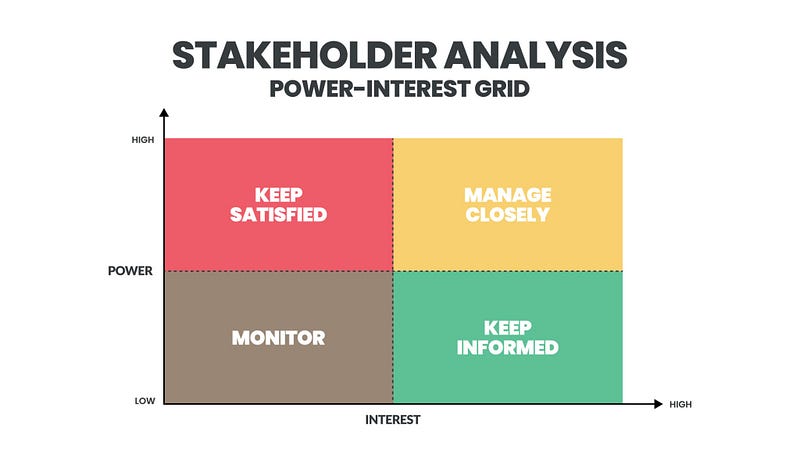
The Fix: Segment your audience. The Executive Sponsor needs a different message than the Technical Lead. Tailor the signal to the receiver.
3. The Optimism Bias
The Mistake: Hiding risks to “protect” the relationship. You hope the problem will go away.
The Reality: Bad news does not get better with age. It gets expensive.
The Fix: Treat risks like data. Share them early and neutrally. (We are monitoring this risk. Here are our options).
4. The Ego Trap (Defensiveness)
The Mistake: A stakeholder challenges your plan, and you argue back.
The Reality: When you defend, you stop listening. You signal that being “right” is more important than the project outcome.
The Fix: Be curious. Ask (Help me understand your concern. What are we missing?)
5. Selection Bias (Ignoring the Quiet Ones)
The Mistake: Focusing only on the loud, demanding stakeholders.
The Reality: The quiet stakeholders often hold the power to veto. Their silence is not agreement. It is often disengagement.
The Fix: Proactively hunt for the quiet voices. Ask (I haven’t heard your thoughts on this yet, and I want to make sure we are not missing your perspective).
The Strategic Advantage
Ultimately, Stakeholder Management is not about being liked. It is about alignment.
When you invest in these relationships early, you change the physics of the project.
When a crisis hits (and it will), a trusted stakeholder becomes an ally who helps you solve the problem. An untrusted stakeholder becomes a judge who sentences you for the problem.
The difference between those two outcomes is rarely technical. It is almost always relational.
Do not overthink this. Look at your current project. Identify one stakeholder you have not truly connected with yet. Maybe it is someone quiet. Maybe it is someone intimidating.
Send a simple message today.
(I would love to get your perspective on how the project is shaping up. Do you have ten minutes to share your thoughts?)
Then, stop talking and listen.
You are not just gathering requirements. You are building the safety net for your future self.
I am incredibly grateful that you have taken the time to read this post.
Please, check my premium newsletters:
Please also check my Book Notes.
I was hoping you could support my work by sharing my content with your network using the sharing buttons below.
Want to show your support and appreciation tangibly?
Creating these posts takes time, effort, and lots of coffee, but it’s totally worth it!
If you’d like to show some support and help keep me energized for the next one, buying me a virtual coffee is a simple (and friendly!) way to do it.
Do you want to check previous Book Notes?
- Book Notes #127: The Laws of Simplicity by John Maeda
- Book Notes #126: Inevitable by Mike Colias
- Book Notes #125: Revenge of the Tipping Point by Malcolm Gladwell
- Book Notes #124: Radical Candor by Kim Scott
- Book Notes #123: The Personal MBA by Josh Kaufman
- Book Notes #122: The First 20 Hours by Josh Kaufman
- Book Notes #121: A World Without Email by Cal Newport
- Book Notes #120: Storynomics by Robert McKee and Thomas Gerace
- Book Notes #119: Getting Things Done by David Allen
- Book Notes #118: Supercommunicators by Charles Duhigg
Do you want to check previous Articles?
- What Senior PMs Know About Communication That Juniors Don’t
- What You Knew About Time at Seven Years Old That You Forgot at Thirty
- What I Wish I Knew About Project Risks When I Started
- The Project Kickoff Guide I Wish Someone Had Given Me
- How to Say No Without Creating Enemies
- The Secret to Handling Stakeholders Early
- 5 AI Prompts That Will Make Your Status Updates Actually Get Read
- Building Confidence as a Junior Project Manager
- How to Lead Your First Project
- A Personal Reflection Before 2026 Starts